Expanding across Europe is full of operational decisions that are hard to make from outside the market. Where to warehouse, where to office, which suppliers to use, which local rules apply, which permits matter, which languages your clients actually prefer. This guide outlines the practical considerations and how one integrated services partner can shortcut most of them.
Office space and fit-out
Most expansions start with a small local office. Picking the right city is half the decision; the other half is how to fit out the office quickly so a local team can start working. Amsterdam, Rotterdam, Antwerpen, Brussel and Hamburg all have flexible office furniture rental and turnkey fit-out options. Our Project Furnishing division can deliver a complete office fit-out in two to four weeks, faster than traditional dealer routes.
Warehousing and 3PL
If the expansion involves physical goods, warehousing is the next decision. The Netherlands and Germany dominate European logistics for clear reasons: deep-water ports, motorways, dense rail networks, and a 3PL ecosystem that scales from one pallet to hundreds of thousands per month. The CBS (Dutch national statistics) publishes annual data on European logistics volumes that consistently puts Rotterdam, Schiphol and the Eindhoven Brainport region in the top tier.
A specialist B2B logistics partner can take on warehousing, picking, packing and onward distribution while the expansion team focuses on customers, not on operations.
Technical infrastructure
For technology-heavy expansions (datacenter capacity, retail point-of-sale, hospitality systems), technical installation is the longest-lead component. Starting that planning conversation early avoids the classic trap of having office space ready but no working IT for the first month. See our Data Centers industry vertical if your expansion involves compute capacity.
Launch events and local presence
An opening event for press, partners and staff is the fastest way to signal that the new market presence is real. Our Event Support division can run launch events across Europe with multilingual crew. A typical launch event includes invited press, key local partners, your incoming country lead, and a tour of the new office or warehouse.
Old-market wind-down
For expansions that involve closing or consolidating an existing operation, the old market needs a clean wind-down. Our E-Waste Recycling division handles IT-asset disposal at the closing site with chain-of-custody and Certificates of Data Destruction. This protects against GDPR exposure and satisfies sustainability-reporting obligations.
Country-specific considerations
Netherlands
English is widely used in B2B. The office market is highly competitive in Amsterdam, more flexible in Rotterdam and Utrecht. Logistics hubs around Schiphol, Rotterdam Port and Eindhoven. Standard work week with strong rights-based protections and a 36 to 40 hour norm. VAT registration usually quick (two to three weeks). Useful starting point: business.gov.nl.
Belgium
Bilingual market (Dutch and French) with some English-only B2B segments. Antwerpen for port logistics, Brussel for institutional and EU-facing offices, Gent for tech and creative. Slightly slower regulatory cycle than NL or DE, but stable. Strong incentive schemes for sustainability and energy-efficient buildings.
Germany
Largest market of the three. Hamburg for port logistics and media, Berlin for tech and creative, Munich for finance and engineering, Frankfurt for finance and datacenters. German-language B2B is meaningful even in technical sectors; localise marketing materials. Strong labour-council protections and works-council requirements above certain headcounts.
Common European-expansion pitfalls
- Underestimating timeline. A realistic NL/BE/DE expansion from kick-off to operating presence is six to nine months, not three.
- Choosing the wrong city. Amsterdam, Brussel and Frankfurt are not always the right pick. Often a tier-two city (Rotterdam, Antwerpen, Hamburg) is cheaper and easier.
- DIY-ing operations. Hiring an in-country office manager to handle furniture procurement, IT install, logistics setup and event management almost always blows the timeline. Use an integrated partner for the first 12 months, then transition.
- Skipping the launch event. No launch means no press, no local-partner visibility, and a slower demand ramp.
One partner for the whole expansion
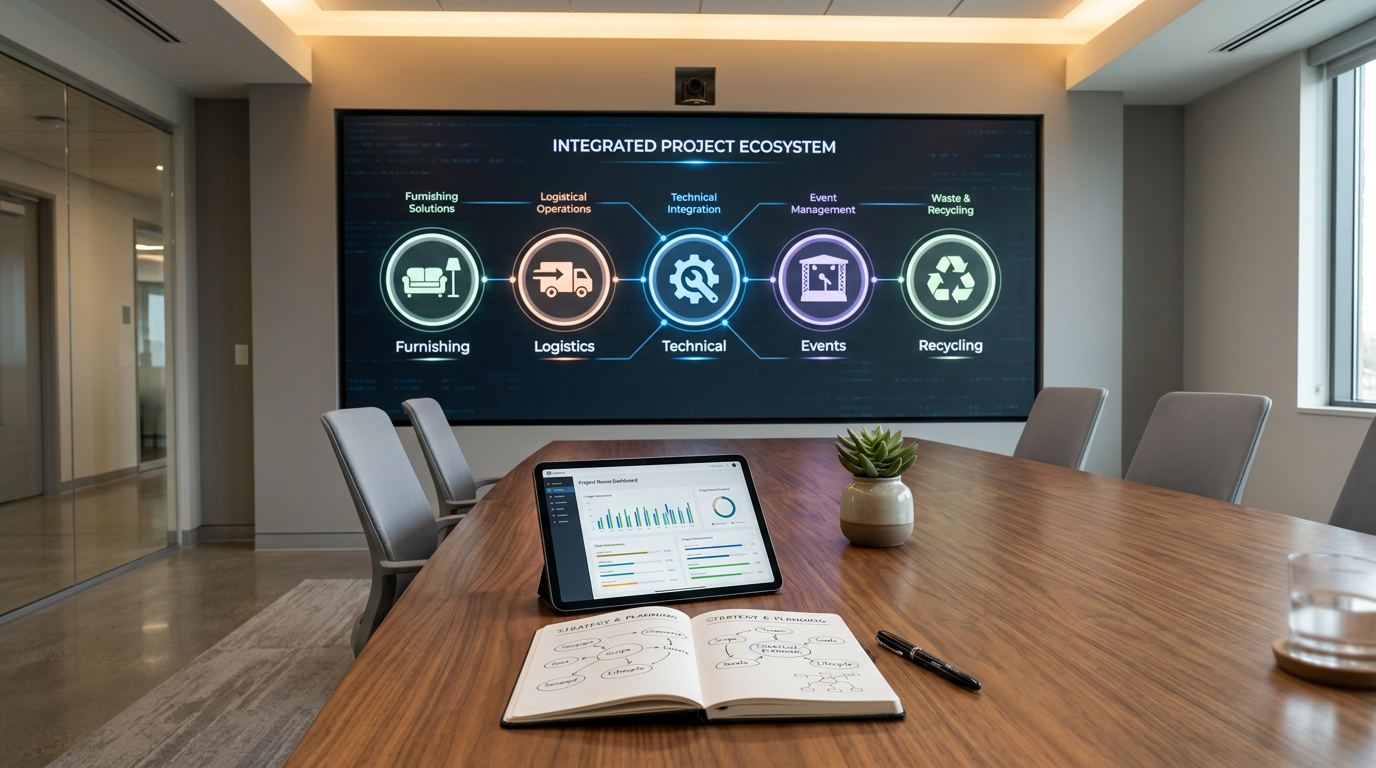
World Wide Mobility Group brings Project Furnishing, Logistics & Warehousing, Technical Installations, Event Support and E-Waste Recycling under one umbrella. Companies expanding across Europe can engage one partner across every operational decision.
Frequently asked questions
How long does an expansion really take?
Six to nine months from kick-off to fully operating presence. Office set-up alone can be done in eight weeks; warehousing or technical infrastructure stretches the timeline.
Which city should we choose first?
Depends on industry. Logistics and consumer goods: Rotterdam or Hamburg. Tech and creative: Amsterdam, Berlin or Gent. EU-policy facing: Brussel. Manufacturing and engineering: Eindhoven or Munich.
Do we need a local entity?
Usually yes within 12 to 18 months. You can operate via a foreign branch for a few months but a registered local entity unlocks better banking, VAT and hiring options.
Can you handle one country and not all three?
Yes. Most clients start with one country and expand. The same project manager and divisions cover all three once you are ready.
Do you provide local hiring services?
No, recruitment is outside our scope. We do introduce clients to specialist local recruiters and EOR providers we trust.
Plan your expansion
Get in touch for an expansion scoping call. We will map your office, warehousing, IT, launch and disposal needs into one schedule before you sign any local contracts.