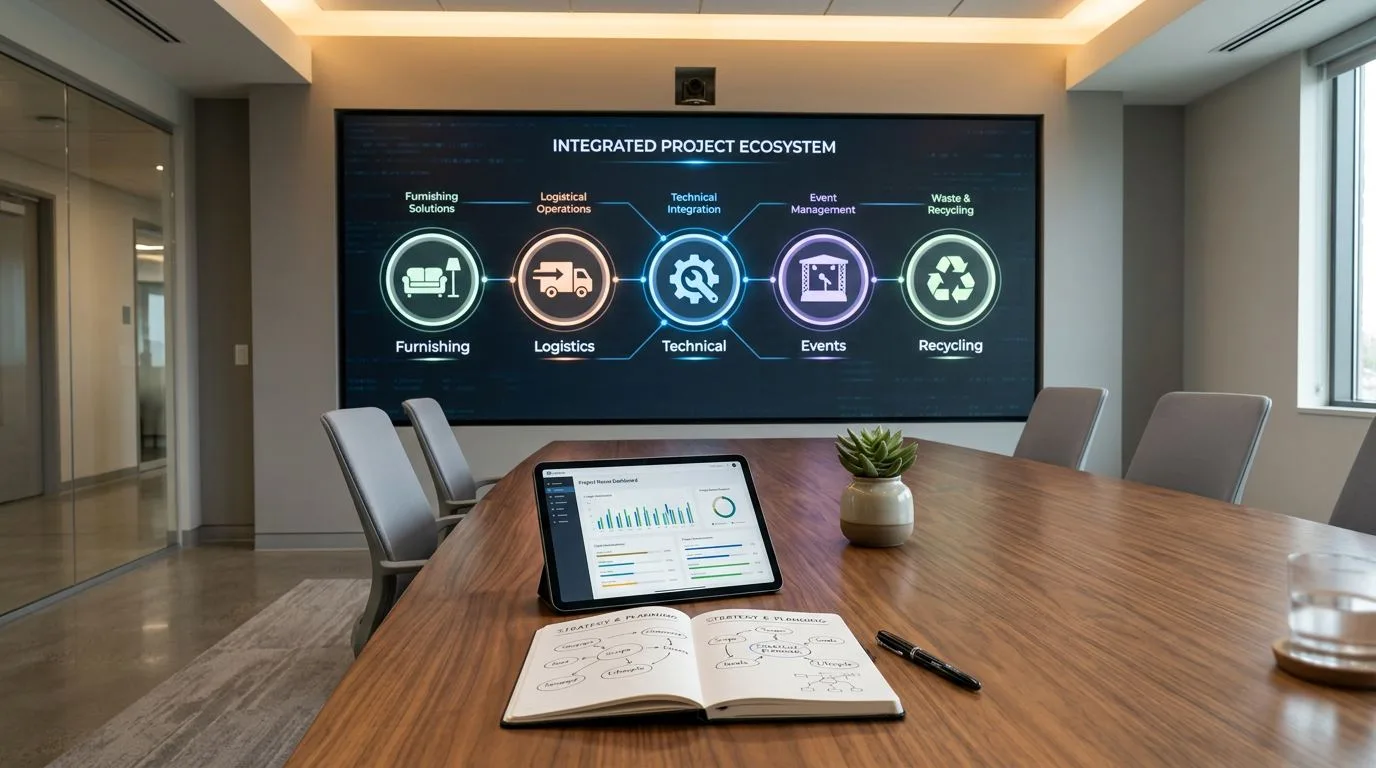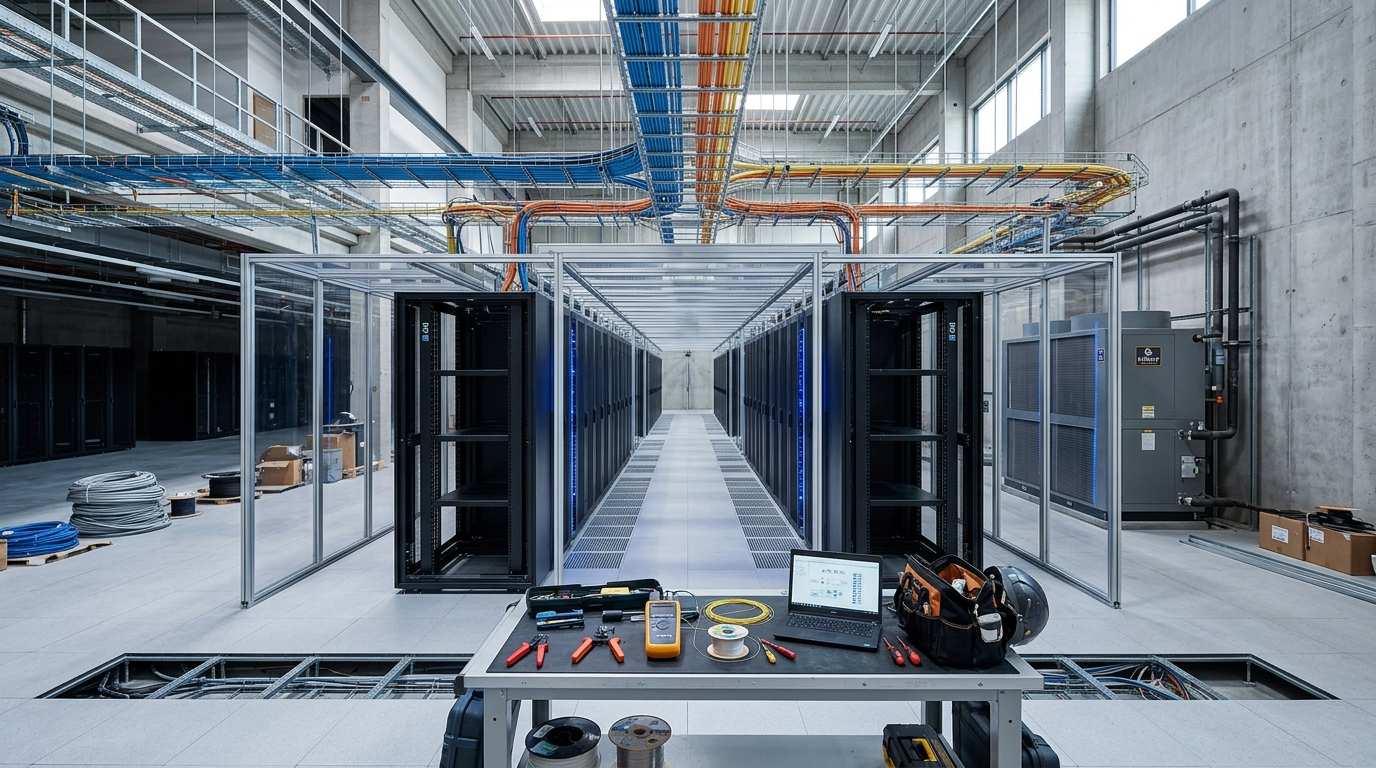
Datacenter builds combine some of the most demanding logistics in commercial real estate with some of the most precise technical installation work in IT. Server racks, CDU cooling systems, structured cabling and Supermicro deployments all need to land on a site that is simultaneously having its facility fit-out delivered and, increasingly, its legacy equipment retired under WEEE-compliant disposal. This guide walks through every phase and the coordination points that benefit most from one integrated provider.
Phase 1: Planning
The planning phase locks rack layout, power density, cooling strategy, network topology and equipment procurement schedule. Decisions made here drive every other phase. A specialist datacenter team should sit alongside the architect, MEP engineer and IT principal during this phase, not afterwards. Critical outputs:
- Approved rack layout and aisle containment plan.
- Power-density-per-rack target (kW), with PDU and PUE assumptions.
- Cooling strategy: chilled water, immersion, CDU rear-door, or hybrid.
- Network topology and structured cabling plan with capacity for two upgrades.
- Equipment bill of materials with lead times and stock-status confirmations.
Phase 2: Equipment procurement and logistics
Datacenter equipment is high-value, heavy and time-sensitive. Server racks, Supermicro chassis, CDU units and switches typically arrive from multiple vendors on different lead times. A specialist logistics partner stages everything in a secure bonded warehouse, sequences delivery to the site to match the installation calendar, and handles last-mile white-glove transport with proper anti-static and shock-monitoring.
The most expensive datacenter delay we see comes from late-arriving switches or PDU rails that hold up an entire row of racks. Specialist logistics partners spot this in week one, not week eight.
Phase 3: Technical installation
Rack mounting, structured cabling, PDU and CDU installation, network configuration and final commissioning all happen in a tight sequence. Specialist datacenter installation crews work alongside the building services contractor so that power, cooling and network all come online on schedule. Key milestones:
- Rack delivery and base-build mounting.
- Structured cabling pull and patch-panel termination.
- PDU installation and per-rack power testing.
- CDU cooling commissioning and leak-test sign-off.
- Network configuration and end-to-end ping/throughput testing.
The Uptime Institute Tier standards are a useful reference for sequencing and acceptance testing.
Phase 4: Facility furnishing and operations setup
Datacenters need more than just racks. Network operations centres, on-site offices, meeting rooms, secure storage and break rooms all need their own furnishing and finishing. This is usually the last phase before handover, and it is the phase most often rushed. A specialist project furnishing team can deliver and install everything in a one-week window: NOC desks with multi-monitor mounts, meeting-room AV, secure storage cages and break-room fit-out.
Phase 5: Commissioning and handover
Full-load testing, redundancy testing, security access setup, fire suppression integration and documentation handover. A small post-handover support window keeps a crew available for the first month of live operations, which is when the bulk of teething problems show up.
Phase 6: Legacy equipment retirement
Increasingly relevant for capacity expansion or refresh projects. Decommissioned servers, switches, UPS units and structured cabling must be retired under WEEE compliance with proper data destruction. Our E-Waste Recycling division handles ITAD with chain-of-custody documentation and Certificates of Data Destruction. For operators reporting under GRI or CSRD, this also unlocks reporting credit for circular-economy disposal.
How one integrated provider helps
World Wide Mobility Group brings Technical Installations, Logistics & Warehousing, Project Furnishing and E-Waste Recycling together under one project manager. Hyperscale and enterprise datacenter operators across Europe engage one team instead of four. See more in our Data Centers industry vertical and case studies.
Frequently asked questions
What rack densities do you support?
Standard installs cover up to 30 kW per rack. For higher densities involving rear-door CDU or immersion cooling, we coordinate with specialist cooling partners under the same project manager.
Do you certify data destruction?
Yes. Our E-Waste Recycling division issues Certificates of Data Destruction with serial-level chain of custody, accepted by ISO 27001 auditors.
How long does a typical hyperscale rack install take?
Roughly two to four weeks per row of 20 racks for a standard install, including cabling, PDU, CDU and commissioning. Lead time on equipment is usually the binding constraint, not install speed.
Can you operate in live datacenters?
Yes. We follow strict live-site protocols including hot-aisle work, no-vibration policies, and after-hours scheduling for sensitive activities.
What countries do you cover?
Europe. Major activity hubs in Amsterdam (datacenter alley around Schiphol), Hamburg, Frankfurt-am-Main and Brussels.
Plan your next build
Talk to us about your next datacenter build, capacity expansion or refresh. One project manager across installation, logistics, furnishing and certified ITAD.